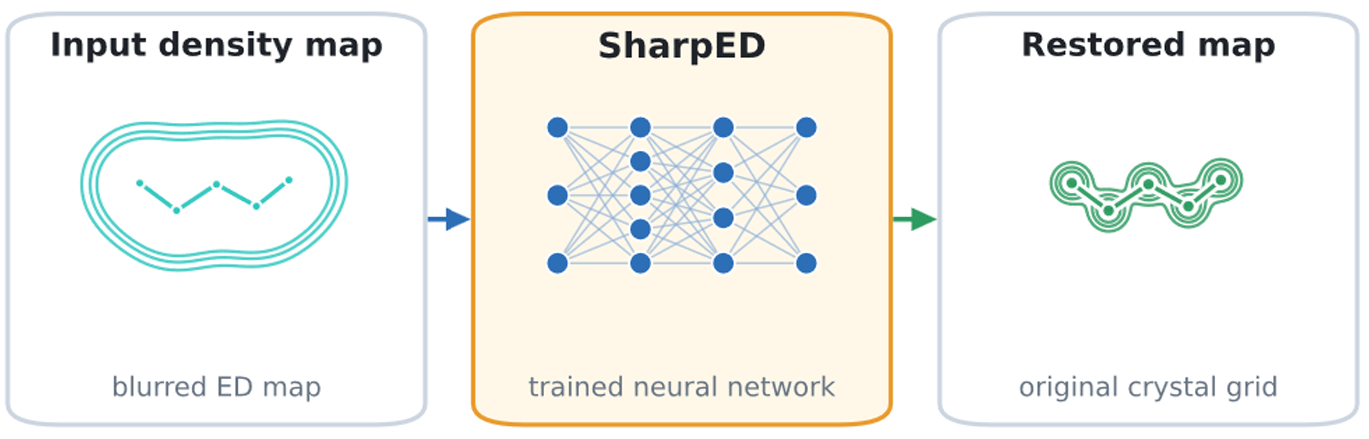
SharpED is a map-to-map neural network that reconstructs local features in crystallographic Fourier electron-density maps affected by limited resolution, incomplete or inaccurate reflections, thermal smearing, and noise.
It operates directly on three-dimensional density and does not require an atomic model as input.
Experimental map → SharpED reconstruction → clearer, more interpretable density.
Learning from paired crystallographic maps
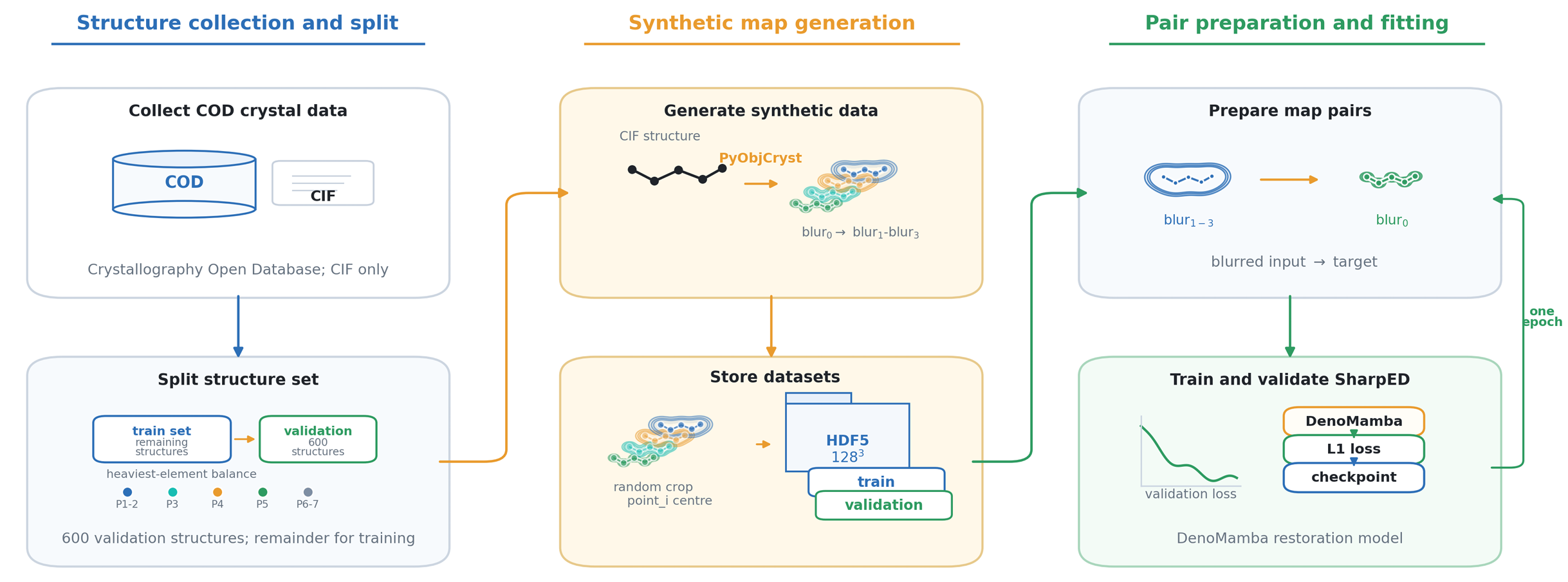
Experimentally determined crystal structures were used to calculate high-resolution reference maps. Corresponding input maps were then generated by introducing crystallographically relevant degradation: limited resolution, missing reflections, thermal smearing, and simulated measurement uncertainty.
SharpED learned to transform these degraded three-dimensional inputs towards the local density characteristics of their high-resolution references. Its training objective is therefore tied to crystallographic density rather than to generic image sharpening.
Crystal structures → reference maps → controlled degradation → paired 3D training examples → SharpED.
The training data were derived from hundreds of thousands of structures from the Crystallography Open Database. The dataset spans organic, inorganic, and metal–organic compounds with diverse elemental compositions and structural complexity.
This diversity exposes the model to a broad vocabulary of local crystallographic density patterns while preserving a clear map-to-map training objective.
SharpED combines a three-dimensional residual encoder–decoder with a bidirectional Mamba bottleneck. The encoder extracts multiscale local features, while the bottleneck integrates information across a wider spatial context. The decoder then reconstructs a three-dimensional output map at the original sampling.
The model predicts density rather than atomic coordinates. It supports crystallographic interpretation without directly generating an atomic structure.
SharpED on experimental data
The examples below use experimental crystallographic maps from different material classes and data regimes. Each comparison shows the same region before and after reconstruction; the reference structure is included only as an interpretive overlay.
Recovering an organic structure from powder diffraction
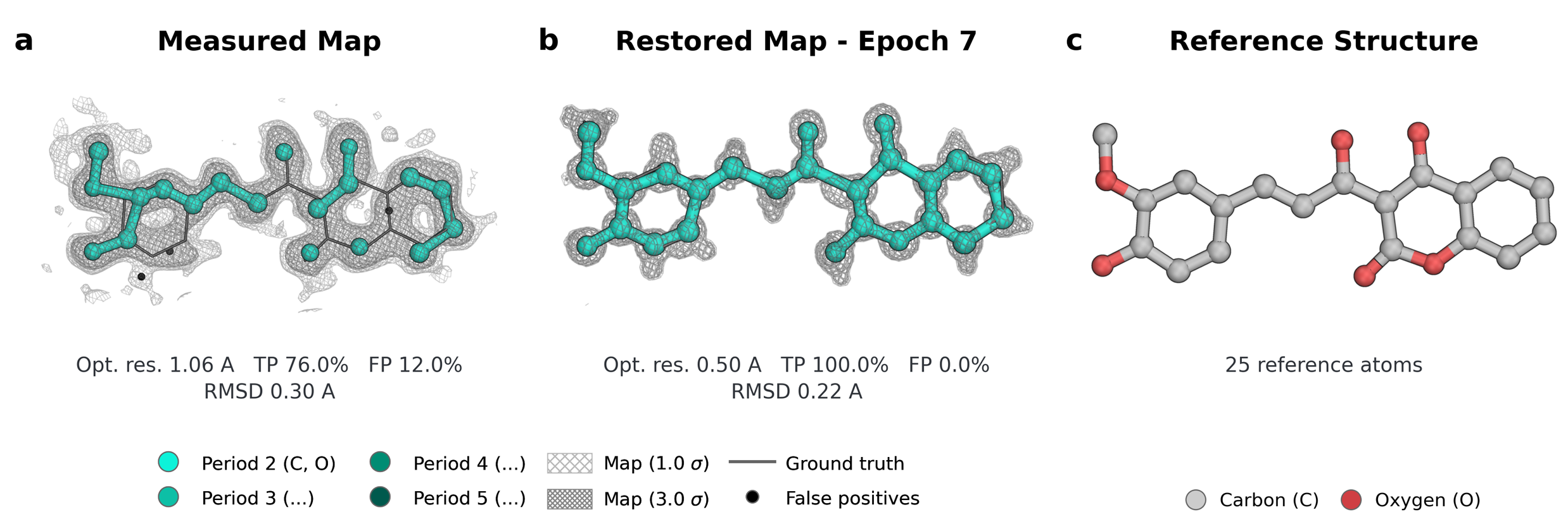
Reflection overlap in powder diffraction reduces the number of independently determined intensities and can produce diffuse molecular density with poorly separated maxima. In the vanillin chalcone example, SharpED transformed the input map that was obtained after solving the phase problem from X-ray powder diffraction data into a substantially clearer molecular representation and improved the recovery and localisation of reference non-hydrogen positions. This example is based on powder diffraction data published in Ghouili et al. 2014.
Vanillin chalcone: a) Original map after solving the phase problem by SuperFlip and atomic model found in the map (greed spheres). Thick lines show the reference model. b) Map reconstructed by SharpED and and atomic model found in the map. The map also shows positions of hydrogen atoms, but thei were not placed to the map. c) The reference structure with atomic types
Revealing light-atom density next to heavy atoms
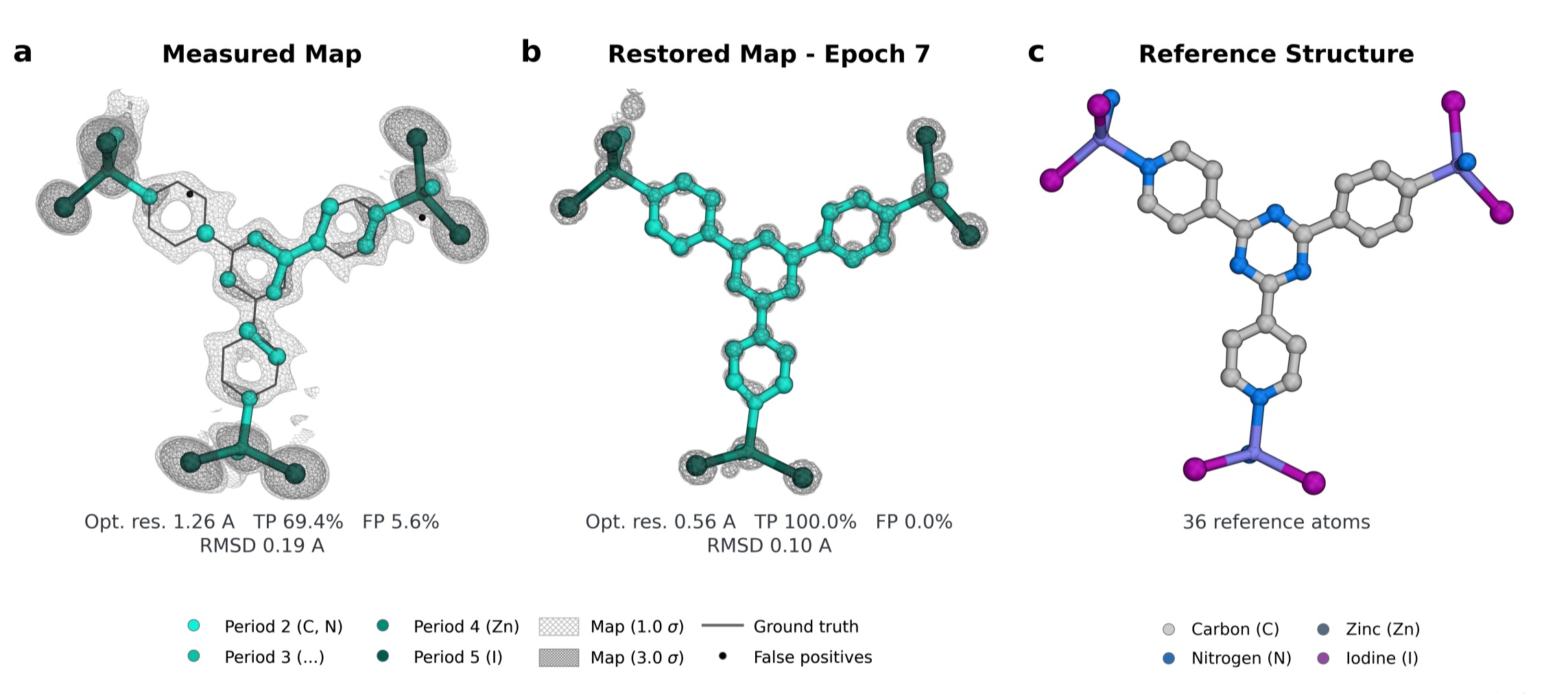
In a Fujita-type metal–organic framework, strong scattering from Zn and I dominates the Fourier map, while the lighter C and N atoms of the organic linker remain weak and poorly separated. SharpED clarifies the linker density and resolves diffuse features into more distinct local maxima.
Fujita-type MOF: light-atom linker density in the original and reconstructed maps.
Clarifying peptide density beyond the training domain
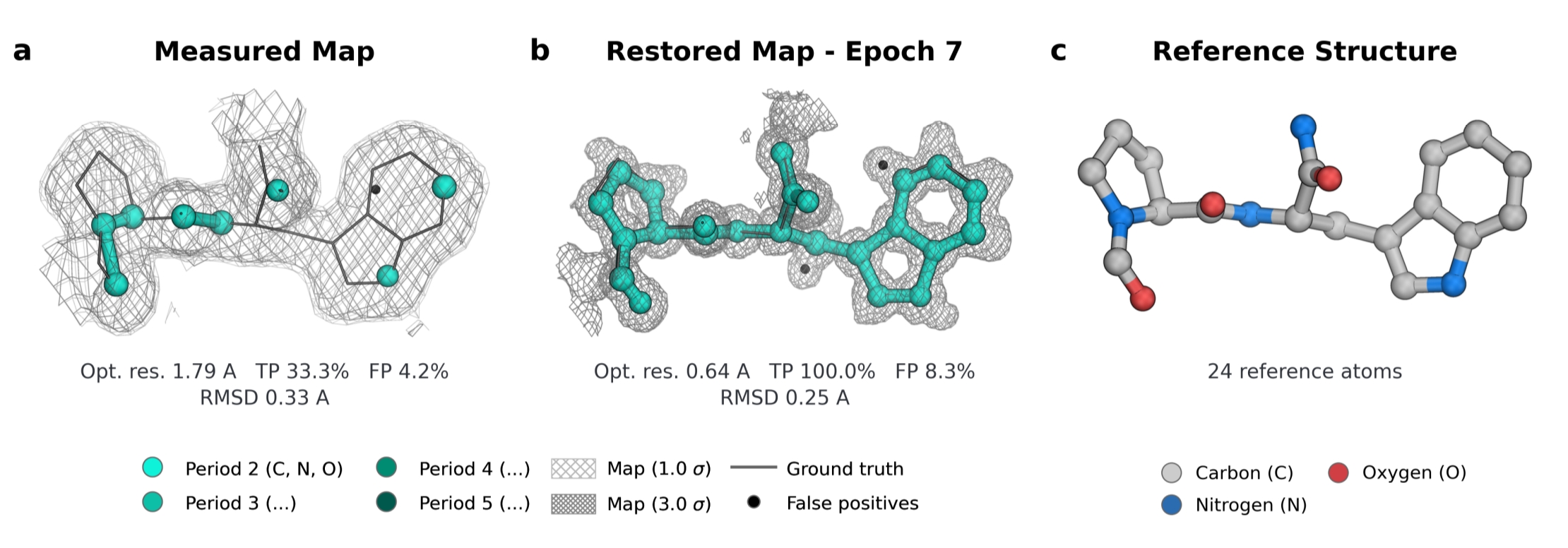
Although SharpED was trained on conventional crystallographic Fourier maps, it also transferred to a macromolecular 2Fo−Fc map. In the selected Pro–Trp segment of PDB 5MGS, reconstruction made the peptide backbone and side-chain density substantially easier to recognise.
PDB 5MGS, Pro–Trp segment: original map and SharpED reconstruction.
Making ligand density easier to interpret
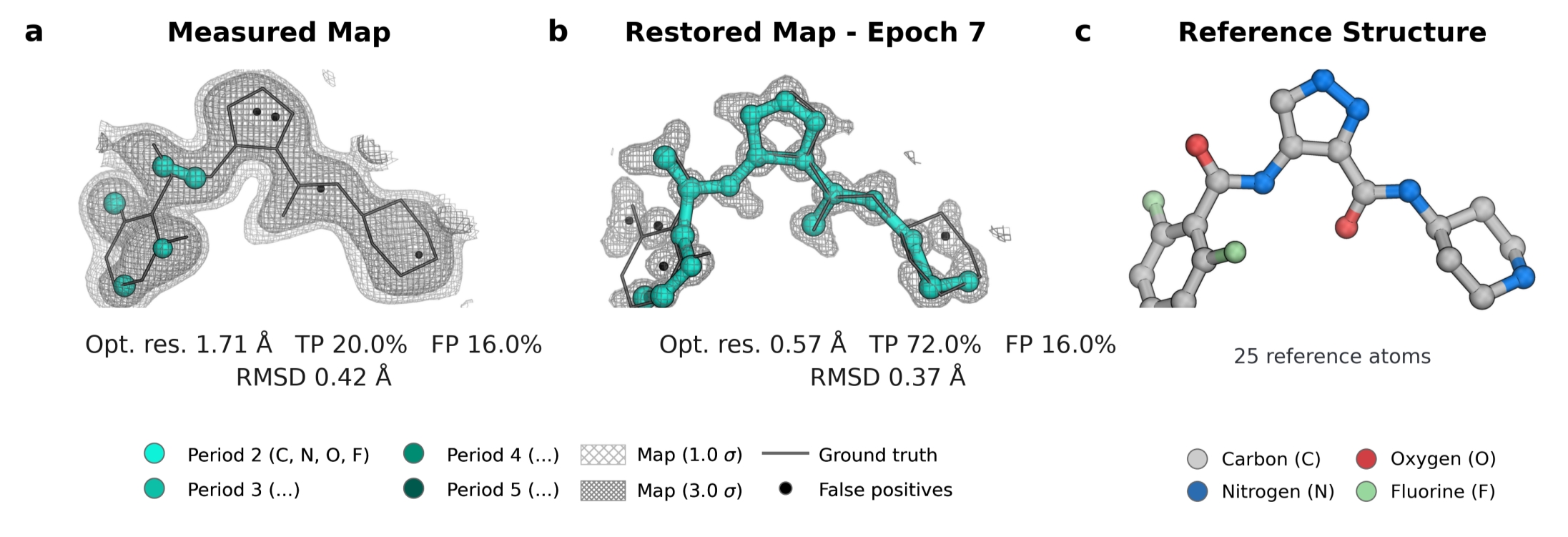
In the LZA binding site of PDB 2VTQ, the original density provided an ambiguous representation of the ligand. SharpED produced a clearer local map in which the ligand shape and several individual atomic features became easier to recognise.
PDB 2VTQ, LZA binding site: original map, SharpED reconstruction, and ligand model.